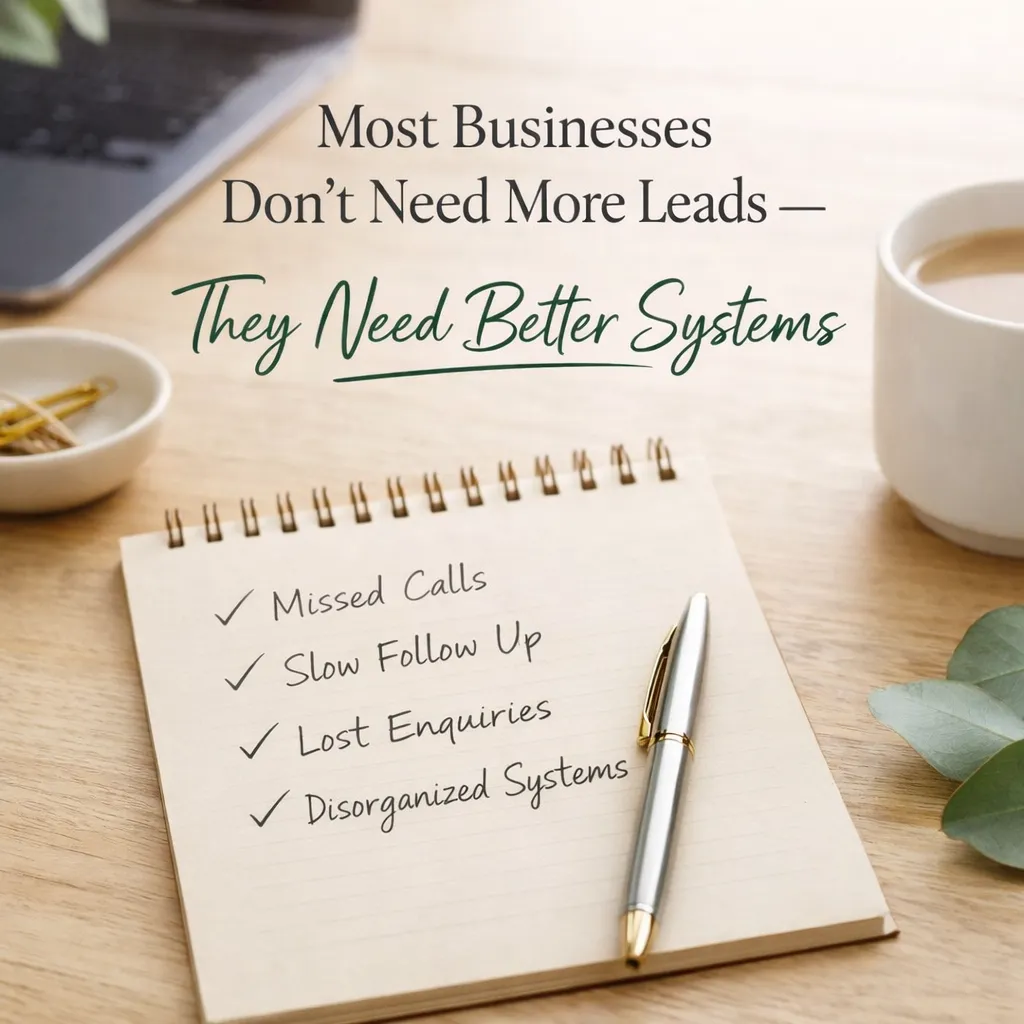
You Don't Need More Leads
Most Businesses Don’t Need More Leads — They Need Better Systems
If your first instinct when business feels slow is “I need more leads”, you’re not alone.
That message is everywhere:
Run ads
Post more content
Increase visibility
Build funnels
Grow your following
And while leads matter, they’re often not the real problem.
In many businesses, leads are already coming in.
They’re just not being handled properly.
And that’s where growth quietly stalls.
The hidden truth: leads are leaking, not missing
Most founders don’t realise how much potential business slips through the cracks each week.
Not because they’re careless — but because they’re human.
It looks like this:
A call comes in while you’re with a client → you miss it
You tell yourself you’ll call back later → you forget
Someone fills out an enquiry form → you reply the next day → they’ve already booked elsewhere
A DM comes in while you’re busy → it gets buried
A lead asks a question you’ve answered a hundred times → it drains your energy to respond again
None of this feels dramatic.
But over time, it adds up.
And the cost isn’t just lost revenue — it’s mental load.
Why “more leads” often makes things worse
Here’s the uncomfortable part no one talks about.
If your systems are messy, more leads = more overwhelm.
More messages to respond to.
More follow-ups to remember.
More pressure to be “on”.
More guilt when you fall behind.
This is how founders burn out while growing.
It’s not that they can’t handle success — it’s that the structure around the success isn’t supportive.
Before adding more volume, the question should be:
“Can my business actually hold this?”
The real growth lever: consistency and responsiveness
People don’t always choose the best business.
They choose the one that:
Responds quickly
Feels organised
Communicates clearly
Makes the next step easy
Speed builds trust.
Clarity builds confidence.
And neither requires you to work harder — they require better systems.
What “better systems” actually means (in practice)
This doesn’t mean turning your business into a complicated machine.
In fact, it’s usually the opposite.
Better systems often look like:
1) Calls being answered — even when you’re busy
If someone calls and there’s no response, many won’t leave a message.
A simple AI receptionist ensures:
Calls are acknowledged
Details are captured
Nothing is lost
2) Instant responses to enquiries
People expect speed — not perfection.
An automated response that says:
“Thanks for getting in touch — here’s what happens next”
is often enough to keep them engaged.
3) Basic qualification
Not every enquiry is the right fit.
Asking a few simple questions upfront:
Saves you time
Sets expectations
Filters out misaligned leads
4) Gentle follow-up
Most sales don’t happen from the first interaction.
Follow-up doesn’t need to be pushy — it just needs to exist.
A calm reminder often makes the difference.
Why this matters for your nervous system (not just revenue)
Here’s the part most systems conversations ignore.
When your business lacks structure, your nervous system becomes the system.
You’re constantly:
Remembering
Checking
Worrying
Scanning
Reacting
That’s exhausting.
Supportive systems reduce cognitive load.
They give your brain permission to rest — and that’s when clarity, creativity and better decision-making return.
A simple question to ask yourself
Instead of asking:
“How do I get more leads?”
Try asking:
“What happens when someone reaches out right now?”
Are they responded to quickly?
Are they guided clearly?
Are they followed up with?
Does it feel calm — or chaotic?
The answer tells you everything.
Growth doesn’t have to feel frantic
Most businesses don’t need a bigger audience.
They need:
Fewer dropped balls
Clearer pathways
Quieter systems working in the background
Often, fixing how enquiries are handled creates more growth than chasing new ones.
Not louder marketing.
Not more pressure.
Just better support.
The calm takeaway
If business feels heavy right now, it doesn’t mean you’re failing.
It usually means your business has grown beyond the systems supporting it.
And that’s not a personal flaw — it’s a structural one.
Better systems don’t just grow revenue.
They create relief.
Sometimes the most effective next step isn’t “doing more”.
It’s making what you already have work better.
